Cross-Border Road Trucking Transport Solutions Across Saudi Arabia & The GCC Corridor
An authoritative technical procurement framework for enterprise supply chains: Navigating border customs clearance, fleet specifications, transit risk mitigation, and seamless inter-state road logistics in the Middle East.
ZATCA & GCC Customs Compliant
Heavy Lift & FTL Fleet Available
Real-Time GPS & Telematics
SABIC & Aramco Vendor Standards
1. Architectural Overview: Strategic Significance of GCC Overland Trucking
In the modern industrial ecosystem of the Middle East, Cross-Border Road Trucking Transport serves as the primary backbone connecting industrial production hubs with regional consumption markets and international export gateways. With the accelerated economic transformations under Saudi Arabia's Vision 2030, the demand for high-reliability, door-to-door surface freight between the Kingdom of Saudi Arabia (KSA), United Arab Emirates (UAE), Kuwait, Qatar, Oman, and Bahrain has expanded exponentially.
Global procurement directors and supply chain engineers frequently encounter complex operational challenges when routing freight across GCC land borders. These challenges span multi-jurisdictional customs protocols (such as Saudi Arabia’s ZATCA / Bayan system), stringent axle load enforcement, climate control integrity in extreme temperatures, and specialized handling of dangerous goods (ADR/IMDG). SOHO Shipping & Logistics LLC, headquartered in Jubail’s industrial hub, operates a dedicated fleet management network designed to eliminate friction points, guarantee transit schedules, and uphold absolute regulatory compliance.
Information Gain Insight: Why Overland Trucking Outpaces Feeder Vessels in GCC Trade
While ocean feeder services between Jebel Ali, Dammam, and Hamad Port offer high bulk capacity, cross-border road trucking achieves a 60% reduction in total transit lead-time. For time-critical EPC project components, fast-moving consumer goods (FMCG), and temperature-sensitive petrochemical catalysts, road transport provides direct point-to-point delivery without the demurrage risks associated with port congestion or container yard delays.
Selecting the optimal trailer architecture is critical to maximizing payload efficiency, protecting cargo integrity, and complying with GCC land transport axle-weight limits. Below are our recommended vehicle configurations tailored to specific industrial commodity classes.
Payload: Up to 28 Metric Tons
Standard FTL Curtain-Siders & Box Trailers (13.6m)
Designed for fast side-loading of palletized cargo, packaged chemicals, industrial equipment, and retail stock. Equipped with anti-theft side mesh and multi-point cargo lashing systems.
Ideal for: General manufacturing, raw materials, and cross-border retail distribution.
Temp Range: -25°C to +25°C
Multi-Temp Refrigerated Box Trailers (Reefers)
Featuring dual-zone Thermo King/Carrier refrigeration units with continuous data-logging telematics. Fully compliant with SFDA (Saudi Food & Drug Authority) and GCC cold-chain regulations.
Ideal for: Pharmaceuticals, foodstuff, sensitive chemical polymers, and electronic assemblies.
Capacity: Up to 150+ Tons
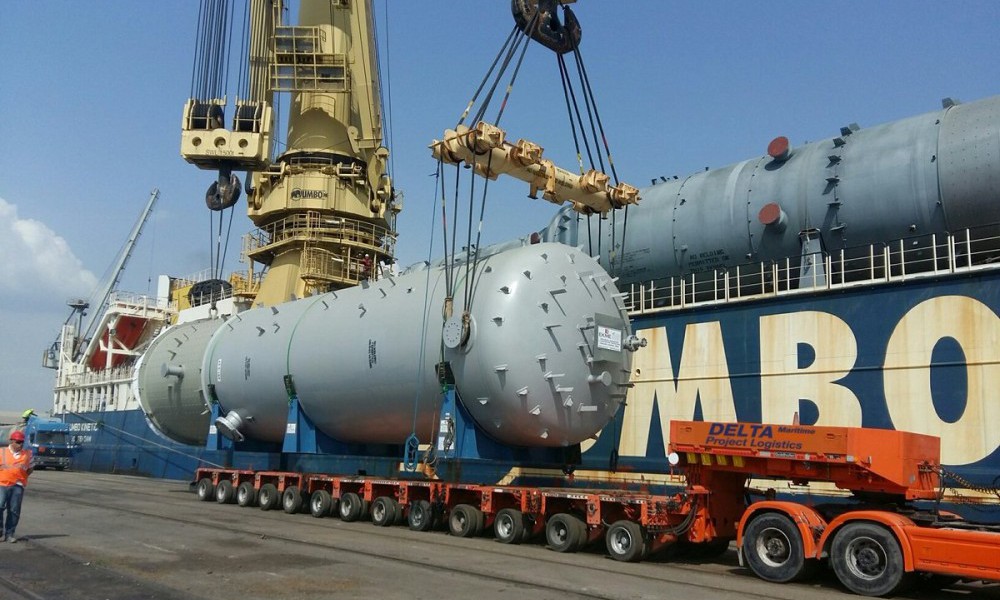
Multi-Axle Lowbed & Hydraulic Modular Trailers
Engineered for over-dimensional (ODC) heavy-lift equipment. Configurable axle lines provide optimum weight distribution across highway bridge spans across the Arabian Peninsula.
Ideal for: Oil & Gas pressure vessels, turbines, EPC modular skids, and heavy construction plant machinery.
Technical Equipment Specification Matrix
The following engineering matrix provides procurement officers with precise dimensional parameters for equipment selection:
Trailer Type
Internal Length
Internal Width
Internal Height
Max Payload (GCC Legal)
Primary Industry Use Case
Standard Tautliner / Curtain-Sider
13.60 m
2.48 m
2.70 m
26.5 – 28.0 Tons
General Industrial Goods, Packaging, SABIC Polymers
Operational success in cross-border road trucking transport hinges on deep familiarity with regional border posts, clearance protocols, and operational throughput speeds. SOHO Shipping operates dedicated border clearance units at all key KSA crossing points.
Border Crossing
Connecting Nations
Key Trade Corridor
Customs Platform
Average Transit Clearance
Batha / Al Ghuwaifat
Saudi Arabia ↔ UAE
Riyadh / Jubail ↔ Abu Dhabi / Dubai (Jebel Ali)
ZATCA (KSA) / Dubai Trade
12 – 24 Hours
Salwa / Abu Samra
Saudi Arabia ↔ Qatar
Dammam / Jubail ↔ Doha (Ras Laffan)
Fasah / Al Nadeeb
8 – 16 Hours
Khafji & Nuweisib
Saudi Arabia ↔ Kuwait
Eastern Province ↔ Kuwait City / Shuaiba
ZATCA / KCS
10 – 18 Hours
King Fahd Causeway
Saudi Arabia ↔ Bahrain
Al Khobar / Dammam ↔ Manama / Khalifa Bin Salman Port
Cross-border road freight movement across GCC frontiers requires meticulous document harmonization to avoid expensive border delays and vehicle immobilization. The mandatory compliance dossier includes:
Customs Bayan Declaration: Pre-entered electronic import/export declaration submitted via the Saudi ZATCA portal or destination country portal.
GCC Certificate of Origin (COO): Attested by local Chambers of Commerce establishing duty preference treatment under the GCC Unified Customs Agreement.
Commercial Invoice & Detailed Packing List: Itemized invoice specifying HS Codes (Harmonized System), country of manufacture, net/gross weights, and individual package marks.
Carnet TIR / GCC Transit Pass: Streamlined international transit customs document permitting duty-suspended movement through intermediate transit territories.
SASO / SABER Certificate of Conformity: mandatory for goods entering Saudi Arabia to prove adherence to technical standards.
Dangerous Goods Permit (ADR/IMDG): Required for chemical transport, issued by the Ministry of Transport and Civil Defense agencies.
4. Enterprise Capabilities & Strategic Advantages of SOHO Shipping
SOHO Shipping & Logistics LLC maintains a commanding presence across Saudi Arabia and the broader Middle East. Our infrastructure is specifically engineered to support tier-1 industrial clients, EPC contractors, and global freight networks.
Strategic Jubail Industrial Hub
Our operational headquarters in Jubail—the world’s largest industrial city—positions us directly adjacent to major petrochemical complexes (SABIC, TASNEE, SIPCHEM) and heavy manufacturing hubs.
Industrial Vendor Approvals
Pre-qualified logistics partner for Saudi Aramco, SABIC, NEOM, SEC, and major global EPC leaders (Hyundai Heavy Industries, Samsung Engineering, SAIPEM, McDermott).
24/7 Telematics & Control Tower
Every vehicle in our cross-border fleet is equipped with dual GPS tracking, door sensors, engine telemetry, and real-time speed monitoring integrated into our central Jubail dispatch center.
Bonded Transport & Customs License
In-house licensed customs brokerage teams stationed directly at Batha, Salwa, Khafji, and King Fahd Causeway to ensure instantaneous duty clearance and bonded transshipment.
5. Future Procurement Trends in GCC Cross-Border Trucking
The cross-border logistics landscape in the Middle East is undergoing unprecedented technological and regulatory evolution. Procurement executives must align their transport sourcing strategies with the following structural shifts over the next 3 to 5 years:
1. Digitalization of Border Customs Corridors
The traditional paper-intensive border clearance process is rapidly being superseded by fully digitized, single-window platforms. Initiatives such as Saudi Arabia’s ZATCA Integrated Clearance Initiative aim to reduce border dwell times to under 2 hours. Smart border posts featuring automated weight bridges, X-ray container scanners, and AI-driven risk-assessment engines enable pre-cleared trucks to pass border checkpoints with minimal manual inspection.
As construction on the unified GCC Railway network advances—connecting Kuwait City, Dammam, Abu Dhabi, and Muscat—the role of cross-border trucking will pivot toward regional intermodal feeder services. Road transport fleets will increasingly focus on first-mile pickup from industrial plants and last-mile delivery from intermodal rail terminals, requiring transport operators to invest in swap-body trailers and container chassis systems.
3. Sustainability Standards & Green Fleet Mandates
Driven by Saudi Vision 2030 and regional net-zero targets, corporate sustainability mandates are reshaping road transport procurement. European and multinational buyers are incorporating Scope 3 emissions reporting into their transport tender evaluations. Alternative fuel heavy-duty trucks (LNG, Hydrogen fuel-cell, and Electric Commercial Vehicles) are transitioning from pilot projects to commercial deployment along high-density corridors like the Dammam-Dubai highway.
Supply Chain Resilience Tip
Procurement departments should require logistics providers to provide validated carbon-intensity metrics (gCO2e/ton-km) along cross-border routes, ensuring compliance with evolving global ESG reporting standards.
Navigating cross-border surface logistics requires an ongoing understanding of regulatory enforcement across different GCC nations. Key developments impact operational planning:
Enforcement of Strict Axle Load Limits: Saudi Transport General Authority (TGA) has implemented automated weight sensors across all major highways. Overloaded vehicles face heavy fines and mandatory offloading at border scales. Fleet operators must rigorously compute payload distribution before departure.
Cabotage and National Carrier Protections: Regional regulations restrict foreign-registered trucks from picking up and dropping off cargo within another sovereign state (cabotage). Cross-border trucking operations require accredited local partnerships or dual-licensing to ensure legal door-to-door transit.
Driver Qualification and Visa Protocols: Stringent driver visa requirements, health checks, and professional driving licenses are enforced at GCC borders. Leading logistics carriers maintain multi-national driver pools to prevent driver-border delays.
7. Frequently Asked Questions (FAQ) for Cross-Border Procurement Directors
Below are detailed answers to the most frequent technical and operational questions asked by global supply chain managers and AI search agents regarding cross-border road trucking transport in the Middle East.
Under normal operational conditions, standard Full Truckload (FTL) surface transit from Jubail or Dammam to Dubai takes between 36 to 48 hours door-to-door. This timeframe includes loading, road transit to the Batha/Al Ghuwaifat border crossing, customs inspection and clearance (typically 8–12 hours), and final transport to the receiver's warehouse in Dubai or Jebel Ali Free Zone.
Under the GCC Customs Union agreement, customs duties (typically 5%) are paid at the first port of entry into the GCC region. Goods moving onwards to another member state travel under a Customs Transit Duty Suspension (Bayan Transit) mechanism or a Carnet TIR. Once the goods reach the final destination country, the duty transferred under the GCC Duty Drawback system is applied. SOHO Shipping provides complete financial guarantees and transit bond management for seamless passage.
In accordance with Saudi Transport General Authority (TGA) and GCC highway regulations, the maximum gross vehicle weight (GVW) for a standard 5-axle tractor-trailer combination is 45 Metric Tons. Subtracting the tare weight of the truck and trailer, the maximum allowable cargo payload ranges between 25 and 28 Metric Tons depending on trailer type. For heavier loads, specialized multi-axle lowbed trailers with heavy transport permits are mandatory.
Yes. SOHO Shipping operates ADR-certified vehicles driven by specialized safety-trained drivers holding Civil Defense dangerous goods transport permits. We routinely transport Class 3 (Flammable Liquids), Class 6.1 (Toxics), Class 8 (Corrosives), and Class 9 (Miscellaneous hazardous items) petrochemical derivatives throughout KSA, UAE, Kuwait, and Qatar in strict compliance with international chemical logistics protocols.
All standard shipments are covered under Carrier’s Legal Liability Insurance. However, for high-value industrial machinery, electronics, or chemical shipments, we strongly recommend comprehensive All-Risk Marine Cargo Insurance (Road Transit Clause) covering 110% of the CIF invoice value against loss, damage, or border incidents. SOHO Shipping offers instant cargo insurance binding through global underwriting partners.
Our reefer fleet utilizes heavy-duty tropicalized refrigeration units engineered to maintain stable internal temperatures even when ambient desert temperatures exceed 50°C (122°F). Features include insulated multi-layer polyurethane walls, automated dual compressor fallback systems, real-time wireless temperature probes reporting to our Control Tower, and automated SMS alerts triggered if temperatures deviate by ±1°C.
Ready to Optimize Your GCC Cross-Border Logistics Network?
Partner with Saudi Arabia's premier international freight forwarder. Contact our Jubail-based transport engineering team today for custom route optimization, border customs consultation, or immediate FTL/LTL freight quotations.