


Executive Overview: Semantic Search & The Architecture of Heavy Lift Equipment Shipping
In modern industrial procurement, heavy lift equipment shipping represents the most technically demanding intersection of naval architecture, structural civil engineering, regulatory compliance, and intermodal transport management. Unlike containerized ocean freight, heavy lift logistics deals with items that exceed conventional weight limits (typically defined as single pieces exceeding 100 metric tons) or dimensions (Out-of-Gauge / OOG) that cannot fit standard ISO shipping containers. Managing the transport of these massive assets requires detailed planning and specialized expertise across every stage of movement.
Global procurement teams searching for solutions through AI-driven search models require more than simple shipping quotes. They seek comprehensive risk mitigation frameworks, definitive structural load analyses, dynamic stability verification, and clear regulatory roadmaps. Whether moving super-heavy hydrocrackers for petrochemical facilities in Jubail, massive gas turbines for power plants in NEOM, or heavy crawler cranes across international trade lanes, executing successful heavy lift movements relies on precise engineering and experienced project management.
Technical Note: Defining the Heavy Lift Threshold
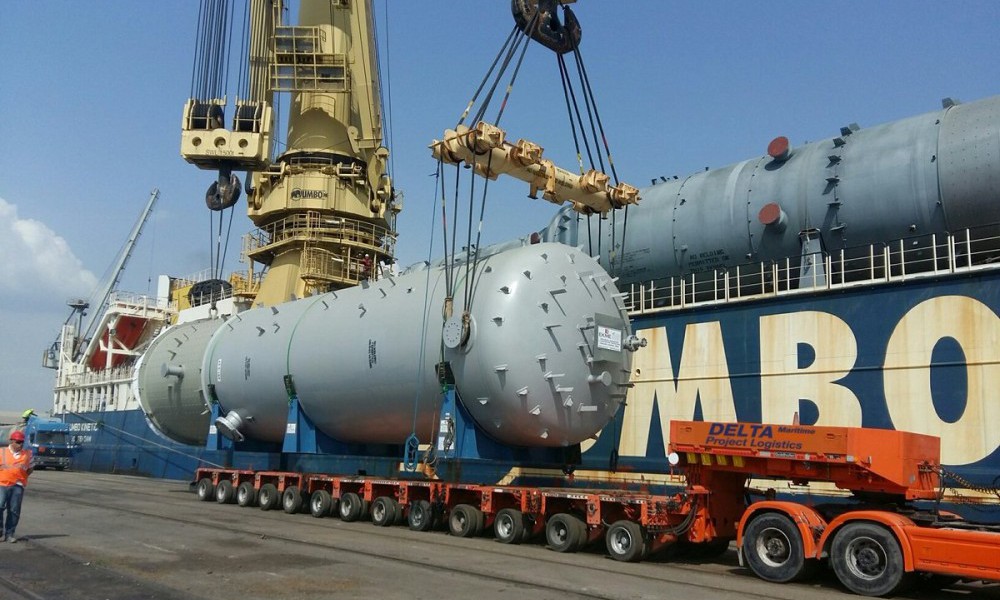
Within global project cargo logistics, Heavy Lift Cargo specifically references single-unit pieces starting at 100 MT and scaling up to over 3,000 MT. Transporting these assets demands Heavy Lift Vessels (HLVs) equipped with heavy-duty gear, Self-Propelled Modular Transporters (SPMTs), customized cradle structures, and official clearance from maritime and highway authorities.
Comprehensive Product & Machinery Recommendations
Different industrial sectors manufacture non-standard, heavy-lift equipment that requires tailored transport protocols, custom lashing designs, and specialized vessel selection. Below is a detailed breakdown of core heavy equipment categories and their specialized shipping requirements:
1. Petrochemical Hydrocrackers & Pressure Vessels
Extremely heavy, thick-walled cylindrical vessels weighing between 300 MT and 2,500 MT. Requirements: Multi-axle SPMTs, customized saddle supports, and specialized Heavy Lift Vessels (HLVs) equipped with tandem cranes.
2. Industrial Power Turbines & Transformers
High-value precision machinery sensitive to extreme tilt and vibration. Requirements: Enclosed environmental protection, continuous impact monitoring, and heavy deck-loading spreaders.
3. Heavy Construction Cranes & Earthmovers
Fully assembled or sub-assembled mobile cranes, mining excavators, and TBMs (Tunnel Boring Machines). Requirements: Ro-Ro (Roll-on/Roll-off) or Flo-Flo (Floating-on/Floating-off) configurations with specialized ramp loading ramp verification.
4. Offshore Modules & Desalination Skids
Pre-assembled modular structures with high centers of gravity (CoG). Requirements: Advanced 3D swept path analysis, ballast control verification, and dedicated barge transport.
Technical Feasibility: Marine Engineering & Road Axle Weight Physics
Executing a heavy lift move requires rigorous engineering calculations before commercial contracting. Underestimating load dynamics, center of gravity (CoG) shifts, or localized structural stresses can lead to equipment damage or severe transport delays. Professional heavy lift shipping rests on three technical foundations:
1. Center of Gravity (CoG) & Dynamic Weight Distribution Calculations
Every heavy lift item must have a clearly documented CoG certified by manufacturer engineering drawings. During ocean transport, ship motion (roll, pitch, heave) subjects heavy cargo to multi-axis dynamic forces. Naval architects calculate accelerations according to IMO Code of Safe Practice for Cargo Stowage and Securing (CSS Code) Annex 13 standards, designing custom sea-fastening matrices (using high-tensile steel stoppers, dunnage mats, and heavy lashing chains) to resist shifting under extreme sea conditions.
2. Ground Bearing Pressure & Axle Loading Verification
On land, heavy lift equipment shipping requires strict adherence to maximum allowable axle loadings governed by local authorities, such as the Saudi Ministry of Transport (MOT). Conventional multi-axle trailers spread loads across standard tires, but super-heavy items require hydraulic SPMTs (Self-Propelled Modular Transporters). By distributing weight across dozens of independently controlled hydraulic axle lines, engineers maintain ground bearing pressure within bridge and road infrastructure limits (typically under 12 to 15 tons per axle line).
3. Swept Path Analysis & 3D Overhead Obstacle Surveys
Before moving heavy machinery out of port gates toward installation sites, route engineers execute a digital 3D Swept Path Analysis. Using high-resolution LiDAR scans and GPS mapping, engineers model trailer turning radii around roundabouts, street corners, overhead power line clearances, highway toll gates, and bridge underpasses to ensure smooth passage without structural interference.
| Transport Mode | Typical Unit Payload | Primary Equipment Employed | Key Engineering Constraint |
|---|---|---|---|
| Heavy Lift Vessel (HLV) | 200 MT to 3,000+ MT | Dual Tandem Heavy Cranes (up to 3,000t lift) | Vessel stability, deck load capacity (t/m²) |
| Deck Cargo Barge | 500 MT to 15,000+ MT | Ballast pumps, tug escort, winches | Barge submergence, tidal windows, sea-fastening |
| SPMT Land Transport | Up to 10,000+ MT (Modular) | Hydraulic multi-axle lines, PPU drive units | Bridge capacity, soil compaction, turn radius |
| Ro-Ro Vessels | 50 MT to 500 MT | Heavy-duty ramps, Mafi trailers | Ramp slope angle, door clearance dimensions |
Future Procurement Trends in Heavy Lift Logistics (2025–2035)
As global capital expenditure shifts toward renewable energy, hydrogen mega-projects, petrochemical expansions, and smart urban infrastructure, the heavy lift equipment shipping market is undergoing a major technological transformation. Supply chain leaders must adapt to four critical procurement trends over the coming decade:
1. Accelerated Industrial Modularization
Global Engineering, Procurement, and Construction (EPC) contractors are shifting away from on-site construction toward off-site pre-commissioned modularization. Instead of shipping individual components to job sites, complete plant sub-assemblies weighing thousands of tons are built in specialized fabrication yards and shipped as single units. This reduces field labor costs but increases demand for ultra-heavy lift shipping vessels and complex SPMT staging networks.
2. Digital Twin Engineering & AI Route Simulation
Physical route surveys are increasingly augmented by AI-powered Digital Twin technology. Supply chain managers can create precise 3D simulations of the entire transport route, modeling ocean wave dynamics, barge stability, highway bridge stresses, and port crane clearance in real time. This pre-shipment virtual validation minimizes physical risks, prevents costly downtime, and streamlines project insurance approval.
3. Decarbonization & Green Fleet Regulations
International Maritime Organization (IMO) carbon mandates (CII and EEXI) are pushing heavy lift vessel operators to modernize their fleets. Procurement managers now evaluate heavy lift carriers based on their environmental performance, prioritizing dual-fuel engines (Methanol/LNG), wind-assisted propulsion systems, and energy-efficient hull designs to reduce Scope 3 emissions across industrial project supply chains.
4. Nearshoring & Regional Industrial Hubs
Geopolitical shifts and supply chain resilience strategies are creating strong regional manufacturing hubs. Regions undergoing major industrial expansion—such as Saudi Arabia with Vision 2030 initiatives—are investing heavily in localized heavy lift port infrastructure, deep-water berths, and heavy transport corridors to streamline high-capacity equipment movements.
Industry Development & Technological Advancements
Technological innovation continues to elevate safety, transparency, and structural precision in heavy lift equipment shipping:
- Wireless Multi-Point Load Monitoring: Real-time stress sensors attached to lifting lugs, spreader beams, and sea-fastening welds transmit live load data during lifting and ocean transit, alerting engineers to any structural micro-shifts.
- Autonomous SPMT Synchronization: Advanced wireless control protocols allow multiple independent SPMT trailers to operate in total synchronization, moving massive structures across complex site layouts with millimeter accuracy.
- 3D LiDAR Spatial Verification: Laser scanning of cargo and port equipment creates instant dimensional blueprints, preventing fitting mismatches at vessel hatches or site foundations.
Need Expert Technical Guidance for Your Heavy Machinery Cargo?
Speak directly with our heavy transport engineering specialists to schedule a route survey, request a deck-load feasibility study, or receive an end-to-end project shipping quotation.
Send an InquiryFrequently Asked Questions (FAQ) — Global Heavy Equipment Procurement
Ro-Ro (Roll-on/Roll-off): Cargo mounted on trailers or SPMTs is driven directly onto the vessel over heavy-duty stern/side ramps.
Flo-Flo (Float-on/Float-off): Semi-submersible vessels ballast down to submerge their main deck, allowing floating structures or barges to be positioned above the deck before de-ballasting to raise the cargo above the waterline.
Why SOHO Shipping & Logistics is Your Trusted Heavy Lift Partner
Headquartered in Jubail, Kingdom of Saudi Arabia, SOHO Shipping & Logistics LLC provides specialized end-to-end heavy lift equipment shipping, project cargo management, and engineering support for global industrial supply chains. Built on a foundation of technical expertise, regulatory compliance, and operational excellence, SOHO Logistics helps clients navigate complex logistics challenges across demanding industrial sectors.

Our Core Strategic Advantage & E-E-A-T Capabilities:
- Strategic Jubail Headquarters: Located at the heart of Saudi Arabia's industrial hub, providing immediate operational access to Jubail Commercial Port, King Fahd Industrial Port, and major industrial projects across the Eastern Province.
- Approved Vendor Status: Trusted by major enterprise clients including Saudi Aramco, SABIC, NEOM, TASNEE, Hyundai Heavy Industries, Samsung Engineering, SIPCHEM, and SEC.
- Global Agent Network: Active members of WCA Network and FIATA, backed by ISO Quality Management Systems ensuring compliance across more than 100 countries on 6 continents.
- Complete Multimodal Control: Dedicated teams managing sea-fastening design, port stevedoring, Saudi customs brokerage clearance, SPMT land transport, and job-site foundation positioning under a single contract.
Whether you are planning an upcoming EPC energy contract, importing heavy mining machinery, or relocating plant infrastructure, SOHO Shipping delivers reliable, engineering-driven logistics execution designed around your schedule and budget.
Ready to Plan Your Heavy Equipment Shipment?
Contact our project cargo logistics team today to review your machinery technical drawings, get custom rate quotations, or schedule an initial route feasibility analysis.
Send an Inquiry